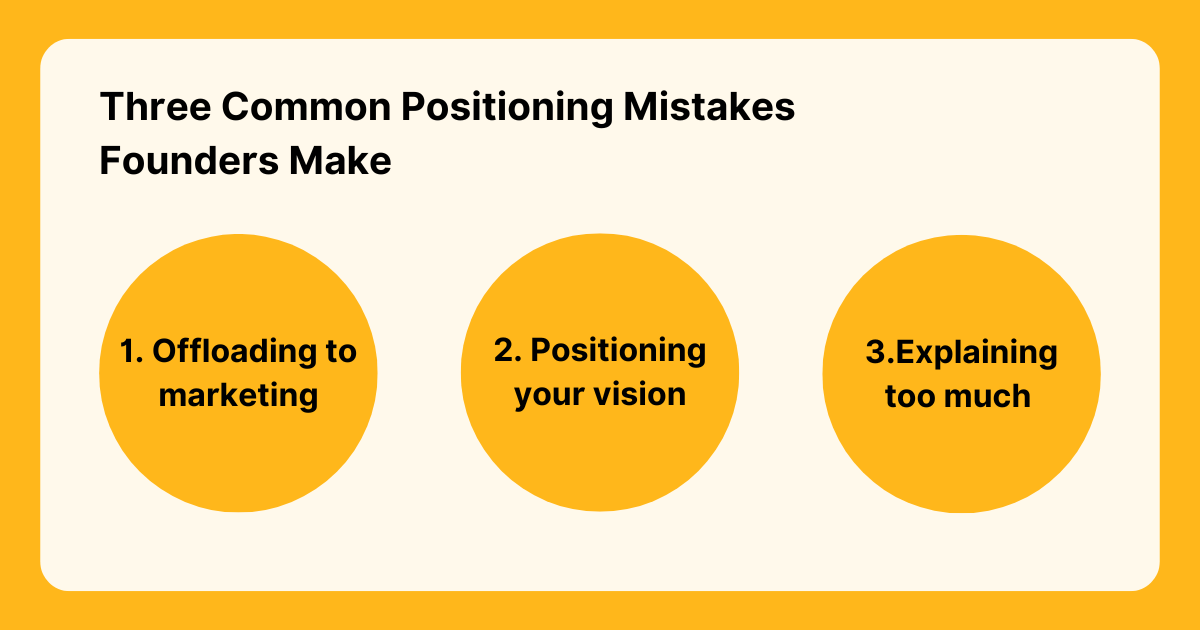
The most common positioning mistakes I see in scaleup founders: handing positioning to the marketing department, positioning the product you're building instead of the product you have, and forgetting that you know too much about your own company to explain it clearly.
All three are fixable. Here's how.
Sure, marketing can take the lead on positioning, but founders who stay hands-off are more likely to disagree with the outcome. This usually leads to continued misalignment on messaging and endless debate.
As a founder or CEO, you're probably the person with the deepest knowledge of the market and the value of your product. Your insights should be central to shaping your positioning.
The fix: set the position at leadership level and build it with your team, because you've now got people with valuable perspectives and data. Marketing executes the position; it shouldn't have to invent it. Here's who should be in the room:
Positioning is a team sport, so make sure your MVPs are on the field.
As a founder, you've likely crafted dozens of pitches and decks that showcase your vision. But remember, your ideal customer only uses your current product.
When your positioning appears on your homepage, it's a promise to customers about the value they'll experience right now, not in the future.
The fix: you'll need separate messaging for investors that speaks to your vision.
But for customers, keep your product positioning firmly grounded in the value you're delivering today. When the next big capability ships, let your positioning grow to claim it.
You know too much. You've lived every decision, every pivot and every feature debate, so the story feels simple from where you stand. That's exactly why simplifying is hard. Founders explain their company from inside their own head, and what comes out is accurate, complete and impossible for a stranger to follow. Meanwhile a buyer gives you a few seconds, decides whether they get it, and moves on.
The fix: get the positioning out of your head and test it on people who owe you nothing. Explain what you do to someone smart who has never seen the product. If they can repeat it back roughly right, you're close. If they hesitate, the problem is the story. The test I use: your tech team and your friend at the pub should both understand it, and describe it the same way.
Recognise yourself in one of these? Good. A positioning mistake you can name is already half fixed. Get the right people in the room and fix it properly, because positioning debt compounds quietly, and the longer you carry it, the more it costs.
Still not sure whether you have a positioning problem at all? Answering these three questions will tell you.